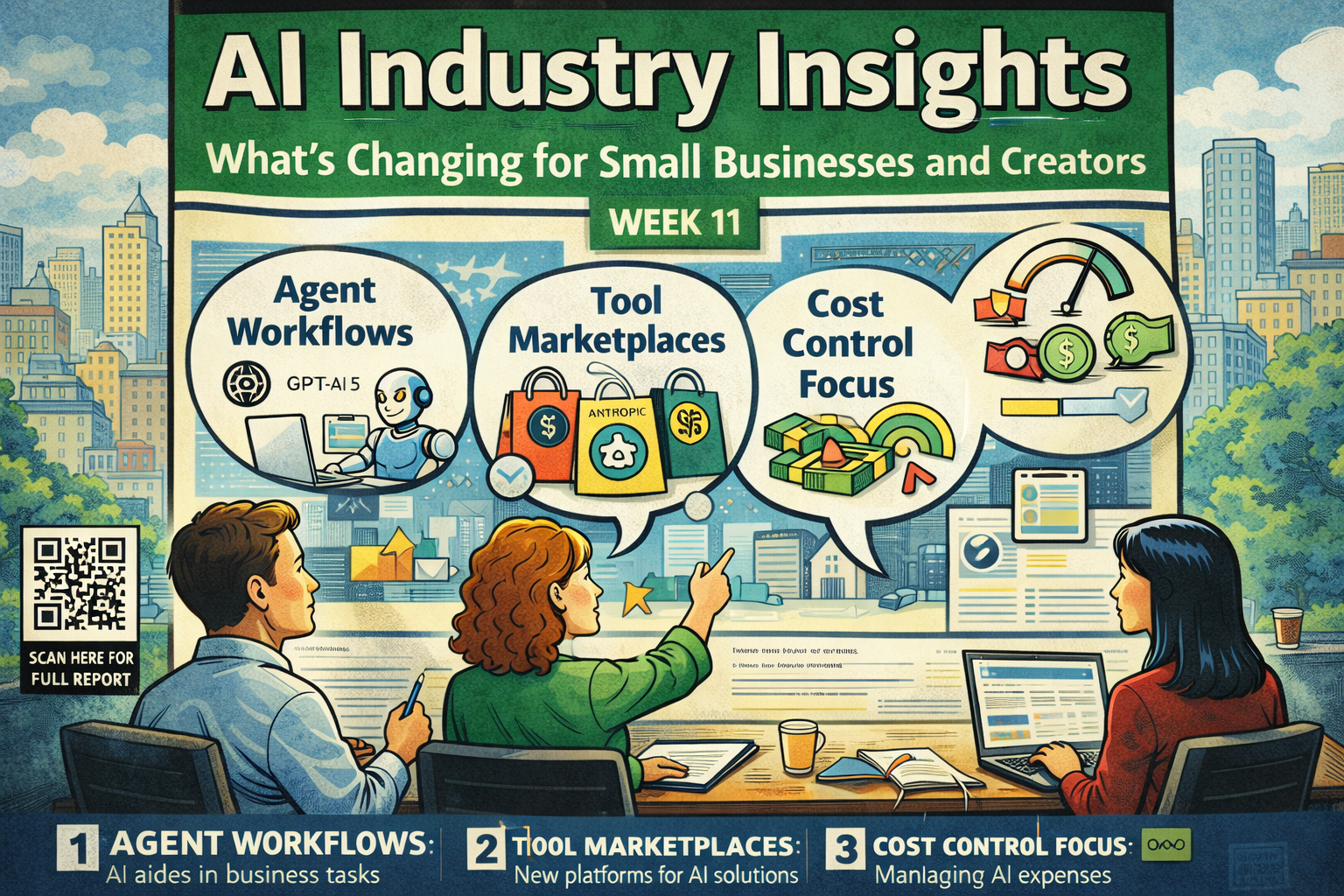

AI industry insights week 11 are less about “a new model is smarter” and more about how AI is being packaged into products that small businesses and creators can actually adopt. Over the past few days, the industry has pushed hard on agentic workflows, tool marketplaces, and deeper integrations into everyday software. The practical result: the value of AI is shifting from prompts to systems—repeatable actions, governed access, and predictable cost control.
What was announced
1) A marketplace model for “enterprise-ready” AI tools
Anthropic launched a Claude Marketplace focused on giving organizations access to Claude-powered tools from partner vendors (and a more structured path to “AI inside the workflow,” not just chat). The headline isn’t the storefront—it’s the strategic direction: distribution is moving toward curated catalogs of vetted integrations, where tool selection, permissions, and governance become part of the product layer. :contentReference[oaicite:2]{index=2}
For small businesses, the marketplace concept matters because it reduces the friction of discovery and setup. For creators, it hints at a future where “AI add-ons” become standardized building blocks rather than scattered browser extensions and one-off subscriptions.
2) Stronger “agent + tool” positioning, with spreadsheet-native workflows
OpenAI’s latest positioning around GPT-5.4 emphasizes agentic workflows and tighter integrations with tools people already use (including spreadsheet-centric work). This signals a continued pivot away from “ask the model questions” and toward “let the model execute multi-step work across systems,” which is exactly what small teams need if AI is going to produce durable ROI. :contentReference[oaicite:3]{index=3}
This is especially relevant for entrepreneurs because spreadsheets remain the operational backbone for pricing, inventory, forecasting, and campaign tracking. If AI becomes more reliable inside that environment, it stops being “content acceleration” and starts becoming “operational acceleration.”
3) The integration war is now the main battlefield
Taken together, these moves reinforce the same industry insight: the next wave of competition is not model quality alone, but distribution and integration. If one platform can live inside your docs, spreadsheets, CRM, inbox, and approval flows—while another remains a separate chat UI—the integrated platform tends to win by default.
This is also why marketplaces and partner ecosystems are suddenly important: they become the mechanism that turns a model into a system.
4) Buyers are implicitly demanding governance (even when they don’t say it)
As more “AI actions” move from suggestions to execution, businesses will care about permissions, audit trails, and failure modes. Even if your customers never mention “AI governance,” they will feel it through procurement questions, security reviews, and demands for predictable behavior in sensitive workflows.
Why this matters for entrepreneurs
AI industry insights week 11 point to a simple shift: AI value is becoming less visible and more structural. Instead of a dramatic “before/after” demo, adoption is happening through incremental features that reduce time, reduce errors, and reduce coordination overhead.
Small businesses: the advantage moves to teams with clean workflows
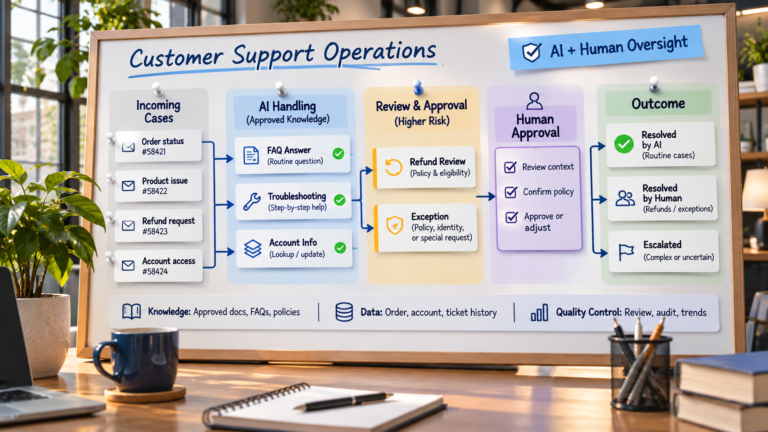
When AI is embedded into operational tools, you get leverage only if your workflow is already coherent. If your sales process is inconsistent, AI won’t “fix” it—it will amplify the inconsistency. If your support triage rules are unclear, AI will route tickets faster… to the wrong place.
This is why the best ROI in this phase comes from pairing AI with process clarity. That’s also the logic behind structured approaches like
AI business automation for solopreneurs
rather than chasing new tools weekly.
Creators: distribution and bundling will matter more than generation quality
Creators already have access to strong generative outputs. The bottleneck is not “can AI write a script,” but “can you produce, package, and distribute consistently without burning out or diluting your voice.”
Marketplaces and integrations matter here because they reduce tool sprawl. If AI tools are delivered as modular add-ons inside platforms you already use, you get fewer logins, fewer exports/imports, fewer broken steps—and a higher chance of a repeatable publishing system.
Editorial insight
Most teams will misread this moment. They will interpret “more integrations” as permission to add more tools. In practice, the opposite is true: deeper integration is your opportunity to simplify your stack, not expand it. The teams that win will be the ones that delete tools—because they finally can.
If you want the “practical test”: does a new AI feature remove steps from a workflow you already run weekly, or does it create a new workflow you now have to maintain? If it’s the second one, it’s noise.
Cost control is becoming a first-class feature
As agentic capabilities expand, cost volatility becomes a real issue for small organizations. A feature that saves time but produces unpredictable usage-based spend becomes difficult to operationalize. The best vendors will win by offering visibility, limits, and controls—not by adding one more model toggle.
This is why it helps to manage AI like any other operating cost: track it, bound it, and review it. A lightweight decision cadence like
AI smarter business decisions
is often more valuable than another subscription.
What to do next
-
Run a “workflow inventory” before you test anything:
list your top 3 repeatable workflows (support triage, lead follow-up, weekly reporting, content repurposing). Only evaluate tools that remove steps inside those workflows. -
Choose one integration “home base”:
decide where AI should live (docs, spreadsheets, CRM, or inbox). If AI lives everywhere, it lives nowhere—and you’ll get stack sprawl. -
Set a cost boundary for agentic usage:
define a monthly ceiling, monitor usage weekly, and require measurable time saved before scaling usage across the team. -
Document your “human review” rules:
pick 2–3 activities that always require human approval (pricing changes, customer refunds, outbound messaging at scale). This is a simple governance layer that prevents expensive mistakes.
AI industry insights week 11 confirm the market’s direction: AI is becoming operational infrastructure—delivered through integrations, marketplaces, and workflow execution. The opportunity for small businesses and creators is to adopt selectively so your system gets simpler, not louder.
If you want a quick starting point for time recovery before expanding tooling, use
AI productivity tools to save time
as a baseline and build outward from there.